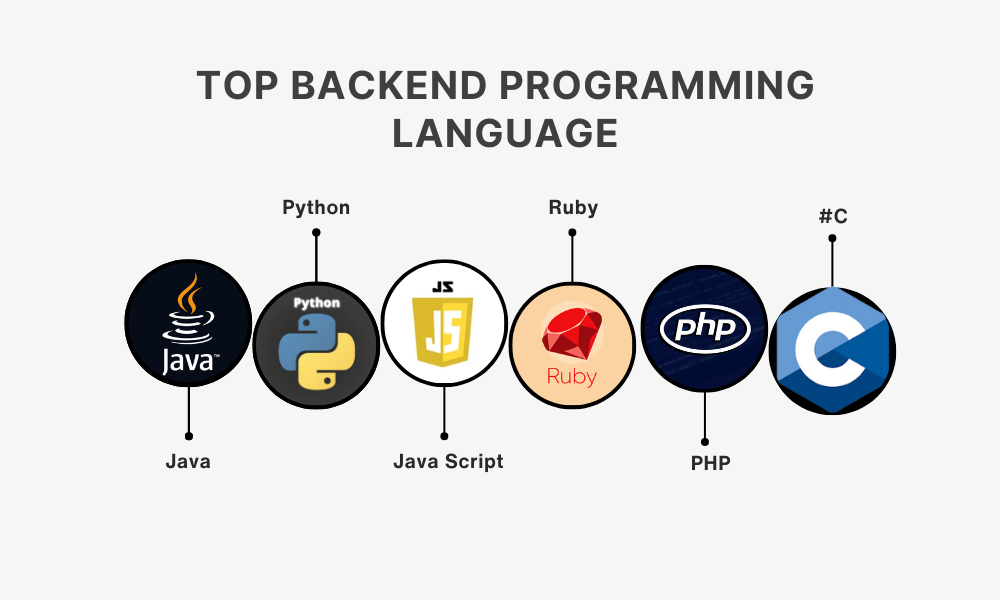
Backend Programming Course – Master Server-Side Development
The Backend Programming Course is designed to provide participants with the essential skills required to build and manage the server-side components of web applications. This comprehensive training covers core backend languages (such as PHP), database integration, server architecture, and API development, enabling learners to create scalable, secure, and high-performance web solutions.
Course Overview
1. Introduction to PHP
PHP (Hypertext Preprocessor) is one of the most widely used server-side scripting languages for web development. In this module, you will learn about PHP’s role in backend programming, its advantages, and how it interacts with databases and front-end technologies. The session also covers the basic syntax and structure of PHP scripts, setting a strong foundation for advanced concepts.
2. XAMPP Setup
Before writing PHP code, you need a local development environment. This section guides you through installing and configuring XAMPP, a popular software stack that includes Apache (web server), MySQL (database), and PHP. You will learn how to set up a local server, run PHP files, and troubleshoot common installation issues, ensuring a smooth development workflow.
3. Print “Hello World”
The traditional starting point for any programming language is writing a simple program. Here, you will create your first PHP script to display “Hello World” on a web page. This exercise helps you understand how PHP embeds within HTML, processes requests, and delivers dynamic content to the browser.
4. Data Types in PHP
PHP supports various data types to handle different kinds of information. This module explains strings, integers, floats, booleans, arrays, and objects in PHP. You will learn how to manipulate and validate data, ensuring efficient storage and processing in web applications.
5. Variable Declaration
Variables are fundamental in any programming language. This section covers how to declare, initialize, and use variables in PHP. You will also explore variable scope (local vs. global), dynamic variable naming, and best practices for writing clean and maintainable code.
6. Comments in PHP
Proper documentation is crucial for code readability and collaboration. Here, you will learn about single-line (//) and multi-line (/ /) comments in PHP. The session also emphasizes the importance of writing meaningful comments for future reference and team projects.
7. Operators in PHP
Operators allow you to perform operations on variables and values. This module covers:
Arithmetic operators (+, -, *, /, %)
Assignment operators (=, +=, -=)
Comparison operators (==, !=, >, <)
Logical operators (&&, ||, !)
String concatenation (.)
You will practice using these operators to build conditional logic, perform calculations, and manipulate strings in real-world scenarios.
Why Enroll in Our Backend Programming Course?
✅ Hands-on training with real-world projects
✅ Expert-led sessions covering industry best practices
✅ Database integration (MySQL) and API development
✅ Practical exercises to reinforce learning
✅ Certification upon completion